
AVIATION FUEL PROBLEMS AND SOLUTIONS: FROM RIFINERY TO WINGTIP
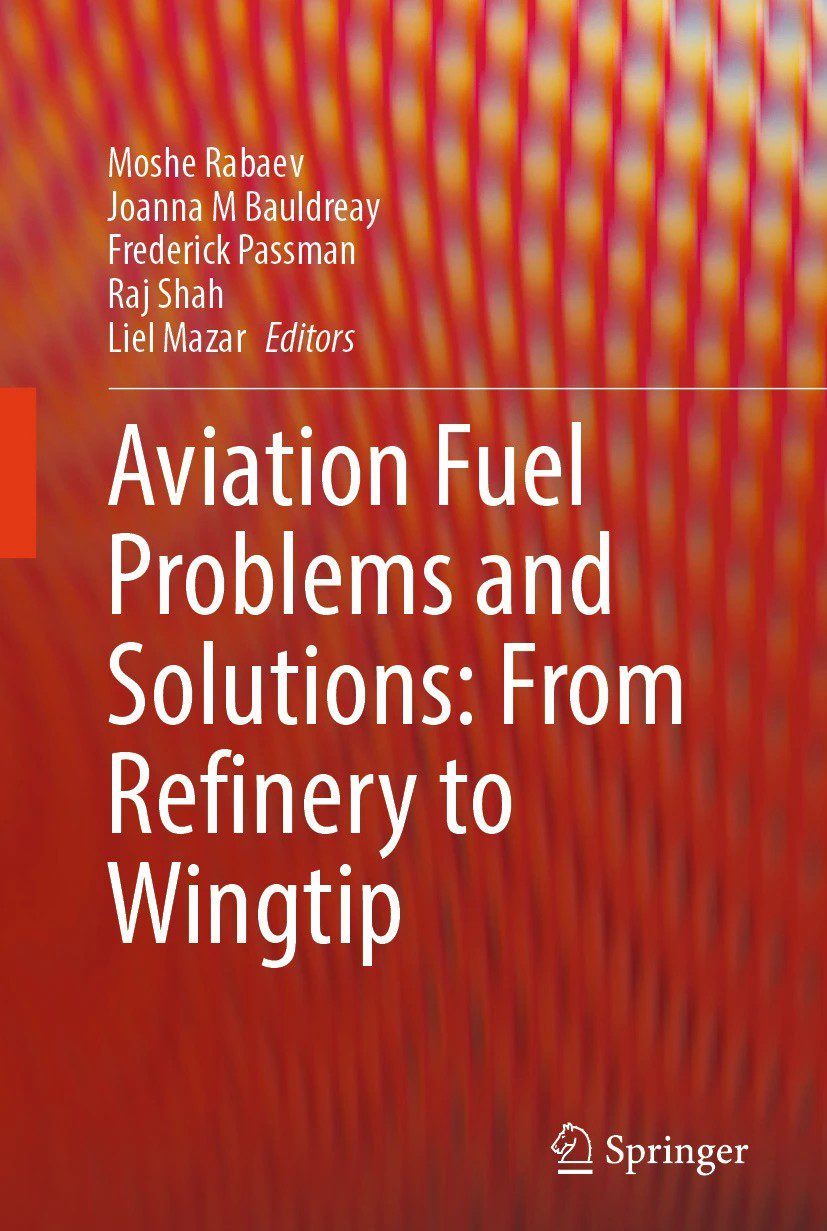
Just Published!
I’m delighted to announce the publication of the book that I co-edited with Drs. Moshe Rabaev, Joanna Bauldreay, Raj Shah, and Mr. Liel Mazar. The book can be purchased at: https://link.springer.com/book/10.1007/978-3-032-05514-9. Or via this QR code:

Contents
Aviation Fuel Problems and Solutions: From Refinery to Wingtip has 15 chapters, each written by one or more internationally recognized subject matter experts. Here’s the table of contents:
| 1 An Introduction to Aviation Fuels and Specifications | 1 |
|---|
| Joanna M. Bauldreay Abstract Flight safety has been the primary driver for the development of avia-tion fuels and their governin specifications since first piston-engined aircraft and later turbine engine-aircraft were developed. For over 70 years in the case of turbine fuels, problems and issues with fuel storage, distribution and usage have led to the specifications being modified as much as the aircraft and engines have changed. Producing fuels to match current specifications reduces the risk of fuel-related prob-lems not associated with handling challenges. This chapter provides an overview of fuel and specification changes, particularly in relation to civil jet fuels, and explains the main performance requirements embodied in the fuel specifications. These are living documents and nowadays allow for the use of synthetic fuel components; additional feedstocks and specification changes to accommodate them can be expected in response to environmental pressures. |
2 Manufacture of Jet Fuel in Refineries | 29 |
| Amiram Groweiss and Joanna M. Bauldreay Abstract Aviation fuels are produced in oil refineries around the world mainly by atmospheric-pressure distillation of crude oil. Refinery activities that take account of crude properties and quality requirements for their complete range of products are essential to produce problem-free, fit-for-purpose aviation fuels. This chapter focusses on jet fuel production, from distillation and heavy stream upgrading processes that set most bulk properties, to finishing processes that control cleanliness and stability. It also addresses briefly more activities in the refineries, such as additivation, sampling, testing, and product release. The slightl different requirements for military grade fuels are discussed as are trends in refinery operations toward production of future fuels. |
3 Building Safety and Performance into Synthetic Aviation Turbine Fuels | 77 |
| Mark Rumizen Abstract Concerns about the security of the supply of aviation fuels, and more recently the sustainability of aviation fuels, have challenged the aviation industry to expand the allowable components used in jet fuel manufacture. This has led to the ASTM D4054 guidance material that sets out how to confirm the suitability of candidate synthetic components. The ASTM D7566 specification then defines requirements for new components and blends made with conventional jet fuel compo-nents that can then drop into jet fuel distribution systems as Jet A or Jet A-1 meeting ASTM D1655, Def Stan 91-091, or similar existing specifications. The evolution of these changes is described, as well as more recent changes that are now allowing some synthetic materials to be coprocessed with conventional refinery streams to create jet fuels with sustainable content. Industry jet fuel product quality guides, such as EI 1533, provide guidance for manufacturers and suppliers of semisynthetic jet fuels that supplement the specification controls used to ensure fit-for-purpose jet fuels. |
4 Aviation Gasoline and Other Fuels for Piston Engine Aircraft | 91 |
| Alisdair Clark, Roger Gaughan, and Melanie Kimble-Thom Abstract Aviation gasoline represents the first fuel specifically developed for flight in an era when the spark ignition piston engine ruled the sky. While the industry largely transitioned to the aviation turbine engine many years ago, the piston engine fleet still performs a useful and important role in global transport. Light aircraft represent a unique solution where ground transport is challenged due to adverse terrain, for example by desert, jungle, water, mountains and snow. In addition, the fleet offers pilot training and recreation to promote aviation across the world, foundations on which the wider industry is built. Aviation gasoline is the primary fuel for these aircraft and, in this chapter, the background to the fuel is presented together with its unique attributes, challenges and solutions. Further, details for aviation compression ignition (diesel) piston engines are also included to promote understanding of alternative power sources. |
5 Additives in Aviation Fuels | 141 |
| Dietmar Posselt, Joanna M. Bauldreay, Amiram Groweiss, and Patrick Bosmans Abstract Aviation fuel specifications set out minimum requirements for a given liquid to be accepted as fit for purpose for use in aircraft. These requirements are a combination of compositional restraints, physical properties and performance criteria that, historically, have proven to produce a fuel that is acceptable for Aviation. Additives have been incorporated into the fuel specifications to help address inherent functional and performance limitations with the fuel. Aviation fuel additives, whether deliberately added or present because of crossover from other fuels during storage and transportation, are tightly controlled in jet fuel specifications. The chapter describes additive usage as well as the approval processes involved for aviation additives to be accepted into aviation fuels, focussing on jet fuel applications. Challenges with additive usage are also addressed and ways to understand, prevent or mitigate the issues are discussed. |
6 The Effects of the Fuel Composition on Non-metal Materials in Aircraft Systems | 187 |
| Melanie Kimble-Thom and Alan Fletcher Abstract The effect of the composition of an aviation fuel, be it kerosene or gasoline, on the non-metallic components of the aircraft fuel system cannot be underestimated. Examples of unintended or undesirable effects of fuel compositional changes include leaking of fuel-wetted seals, swelling of polymeric fuel hoses, and removal of organic coatings from metal substrates. These events illuminate the importance of considering the impacts of changes in fuel formulation or composition. The complexity of the potential list of non-metallic materials, and determining the means of testing and evaluating data, is not immediately obvious. Considering the increasing contemporary efforts to develop alternative fuel sources, formulations, and compositions, the activities to support those challenges become more expansive, touching materials which may have a legacy of decades without being reviewed. While not an exhaustive discussion, the following chapter endeavors to provide a foundation for identifying challenges and developing the means for evaluating data. |
7 Aviation Fuel Stability | 223 |
| Steven Zabarnick, Robert E. Morris, and Josefa Ben-Asher Abstract The term “jet fuel stability” covers a variety of fuel properties that result from the fuel’s chemical composition upon production, as well as changes to these properties upon fuel degradation in the supply chain and upon use in aircraft engines. Stability is ordinarily separated into storage stability, the ability of a fuel to resist degradation during supply chain transport and storage, and thermal stability, the ability of the fuel to resist degradation during exposure to relatively high tempera-tures. This chapter summarizes the fuel degradation processes which occur in these two regimes, details the test methods employed, and offers guidance in preventing and mitigating the effects of these degradation mechanisms. |
8 Supply Chain Risk Management (SCRM) of Fuel for Aviation | 249 |
| Richard Bruce Knapp, Barbara Mooney, Curtis T. Stough, James M. Eberhardt, Renrick Atkins, Rebecca Purcell, Lori Taylor, Kelley Jackson-Cherry, Cheng Yen, Yan Guo, Makeena Stephens, Daniel Baniszewski, Keith Mills, Mark Mizrahi, Michael Heidbreder, and Patricia Wilkins Abstract Supply Chain Risk Management (SCRM) within the petroleum industry often represents a complex logistical challenge. Risks include aspects such as planning, identification, analysis, response planning, and monitoring. The petroleum supply chain involves diverse processes, from sourcing to delivery, with a focus on collaboration due to its segmented nature. Risk factors can be found at different supply chain segments, including source of supply, refinery, distribution, and storage. |
9 Common Practice in Aviation Fuel Handling Equipment | 269 |
| Pierre Poitras, Jim Gammon, Daniel E. Kadlecek, and Amy Carico Abstract Ensuring flight safety starts with proper handling of aviation fuel. This chapter explores key practices for maintaining equipment, managing fueling operations, and avoiding mistakes like misfueling and contamination. It highlights the importance of delivering the correct grade and quantity of fuel, with a focus on over-wing fueling challenges. Practical measures such as using grade-selective nozzles, clear wing decals, and verification steps are discussed to reduce the risk of errors. The chapter also addresses the increasing problem of additive misfueling, particularly confusion between Diesel Exhaust Fluid (DEF) and Fuel System Icing Inhibitor (FSII). It explains the consequences of such mistakes and emphasizes the importance of regular testing and calibration to detect issues before they escalate. Maintenance and storage of fueling equipment are equally critical. From using dust caps to prevent contamination to identifying wear and tear early, the role of fuelers in maintaining fuel quality is emphasized. Proper storage of sampling buckets and attention to hydrant systems are also covered as essential parts of the process. The chapter compares fueling operations at large airports, where equipment is maintained rigorously, to remote locations, where longer storage times and periodic maintenance increase risks. Regardless of the setting, the chapter underscores the need for proactive main-tenance and strict adherence to industry standards to ensure the reliability of fuel handling systems and, ultimately, flight safety. |
10 Aviation Fuel Filtration Systems | 295 |
| John Leonard, Kimberly Morrison, and Samantha Glenn Abstract This chapter provides an overview of aviation fuel filtration systems. Filtration systems are designed primarily to remove particulate contamination from fuel products as they are transported from refinery fuel tanks, ultimately to aircraft. Filtration systems also strip dispersed and free water from fuels. EI maintains EI 1550, handbook on equipment used for the maintenance and delivery of clean aviation fuel. The handbook includes all published and approved technology and provides additional details that are not covered in this chapter. This chapter will describe different types of filtration equipment, filter media, and the most common problems that can degrade filter performance. |
11 Insights into Aviation Fuel Sampling Processes | 325 |
| Moshe Rabaev, Liel Mazar, Yalfal Siyum, Haim Judah, and Frederick J. Passman Abstract To ensure flight safety, it is crucial to supply engines with the appropriate quality of fuel consistently. The fuel quality is verified through proper fuel sampling methods for field and laboratory testing. This chapter outlines official standards and reviews relevant literature on fuel sampling techniques, including tools and containers designed for various sampling points. The impact of local defects—such as poorly positioned sampling valves, sloping piping sections, or tilted vessels— on sampling accuracy is also examined. Further, the chapter explains methods for obtaining representative and indicative samples from fuel lines, tanks, and filters to diagnose specific issues. Special attention is given to the unique challenges asso-ciated with sampling from aircraft fuel tanks. The chapter also addresses incidents requiring sample collection for forensic analysis, detailing solutions for areas with limited access and sampling from ground-based and aircraft filters. Lastly, the chapter provides an in-depth discussion on sampling for microbiological testing, including the associated chain-of-custody documentation required for such tests. |
12 Aviation Fuel and Fuel System Microbiology | 367 |
| Frederick J. Passman, Graham Hill, and Gareth Williams Abstract Uncontrolled microbial contamination can cause or contribute to a number of problems in aviation fuels and fuel systems. The most common problems include fuel system biodeterioration, biofouling, and degradation of fuel properties. This chapter provides an overview of aviation fuel and fuel system microbiology, its detection, and its control. |
13 Corrosion in Aviation Fuel Systems | 415 |
| Alec Groysman Abstract Previous chapters shed light on crude sources and processing, additives, and microbiological growth in aviation fuels. Logically, they connect with corrosion. This chapter explains general principles and fundamentals of corrosivity of aviation fuels, how to control, monitor, and prevent corrosion of metallic parts (and partly polymers) in contact with aviation fuels. |
14 Test Methods and Their Significance for Aviation Fuel Quality Testing | 459 |
| Konstantin Tartakovsky, Marlin D. Vangsness, and Moshe Rabaev Abstract The remarkable safety of air travel compared to land transport is achieved through systematic risk management, failure investigation, and continuous improve-ment. A crucial area where these principles are applied is in preventing fuel system issues caused by aviation fuel contamination, which can pose acute and long-term risks during storage, transport, or use in aircraft fuel systems. Fuel quality assurance (QA) laboratories employ standardized protocols to ensure that aviation fuels comply with the specifications and limits defined in standard test methods and to detect many contaminants that can cause considerable short-term damage to the fuel system. However, routine analysis cannot identify numerous other contaminants that might severely damage the ground and aircraft fuel systems. In addition, to prevent re-contamination, the nature and source of the contamination must be determined. Where contamination is suspected, analytical chemistry laboratories have methods for deep fuel analyses that can meet these challenges. This chapter provides a general overview of some contaminants often found in fuels and suggests ways to detect them. |
15 Aircraft Failure Analysis Induced by the Fuel or Fuel System | 491 |
| Albert Schmidt, Moshe Rabaev, Yalfal Siyum, Haim Judah, and Liel Mazar Abstract This chapter provides a comprehensive analysis of aircraft failures induced by fuel or fuel system issues. The failures are categorized into four main types: fuel starvation, fuel exhaustion, fuel contamination, and wrong fuel usage. The chapter explores how these failures can lead to safety incidents or accidents, supported by real-world case studies. It highlights the importance of proper fuel system maintenance, monitoring, and adherence to safety regulations. The chapter also addresses the role of international regulatory bodies, such as the International Civil Aviation Organization (ICAO), and national agencies, such as the Federal Avia-tion Administration (FAA) and the European Union Aviation Safety Agency (EASA), in setting certification standards for fuel systems. Despite global standards, compliance varies, and the chapter emphasizes the need for harmonized safety measures across jurisdictions. Additionally, the analysis delves into the risks posed by various contaminants—such as water, solids, and microbes—within fuel systems, and examines the dangers of using incorrect fuel types. The chapter concludes by stressing the crucial role of technical investigators and fuel engineers in conducting thorough failure analyses and implementing preventive measures to enhance aircraft safety. |
Reviewers
The list of reviewers is every bit as illustrious as the list of authors. The following experts reviewed the book’s chapters:
David Abdallah, Dave Atwood, Elizabeth M. Bowman, Naphtali Brodsky, John Buffin, Jack Burgazli, Myrsini Chronopoulou, Jim Gammon, Tina Gleaves, Daniel E. Kadlecek, Jason Lee, Chris Lewis, Brenda Little, Madi Mohtadi, Micki Overberg, Paul Rawson, Francois Ropital, Joel Schmitigal, Stan Seto, and Ron Wilkinson.
Publication Details
DOIhttps://doi.org/10.1007/978-3-032-05514-9
- Hardcover edition – ISBN 978-3-032-05513-2
- Softcover edition – ISBN 978-3-032-05516-3
- eBook – ISBN 978-3-032-05514-9
- 565 pp
- 26 black and white + 175 color illustrations
I know that I speak for my co-editors and the authors when I express my hope that this book will become a frequently used resource for aviation industry stakeholders.
